Add ZCP to your hyperscaler.
Keep what works. Fix what doesn't.
You do not have to rip and replace your hyperscaler to regain control over cost, sovereignty, or DR. Run ZCP alongside AWS, Azure, or GCP. Move the workloads where hyperscaler economics break down: egress, sovereign workloads, disaster recovery, and predictable baseline capacity.
4 - 6 week pilot · CAD billing · No hyperscaler commit disruption · S3-compatible from day one
- Egress
- $0 always
- Object storage
- $0.024 / GB / mo
- Hybrid pilot
- 4 - 6 weeks
- Foundation
- Open source
Why hybrid, why now
The hyperscaler is not wrong. It is not the only answer.
Hyperscalers solved a real problem and they keep doing it well: global presence, managed services, elastic burst, deep ecosystems. The pain is concentrated in a handful of workloads where the pricing model, jurisdiction, or vendor concentration becomes the constraint. Those are the workloads ZCP is built for.
Pricing control
Hyperscaler egress, premium tiers, and per-feature add-ons compound. Hybrid moves the expensive parts to a vendor whose pricing model rewards your usage shape instead of punishing it.
Concentration risk
Most enterprises sit on one hyperscaler for 80 %+ of their footprint. A second operator under a separate corporate jurisdiction is the cheapest insurance against vendor lock-in, regional outage, and policy surprises.
Sovereignty by workload
Not every workload needs the same jurisdiction. Tag the ones requiring it, route them to ZCP, and stop forcing a global compliance decision onto every line of your estate.
Reference architectures
Four ways to slot ZCP into your hyperscaler estate.
Each pattern stands on its own, pick one and start there. Or stack them as you find traction. ZSoftly engineers help scope the right entry point for your environment.
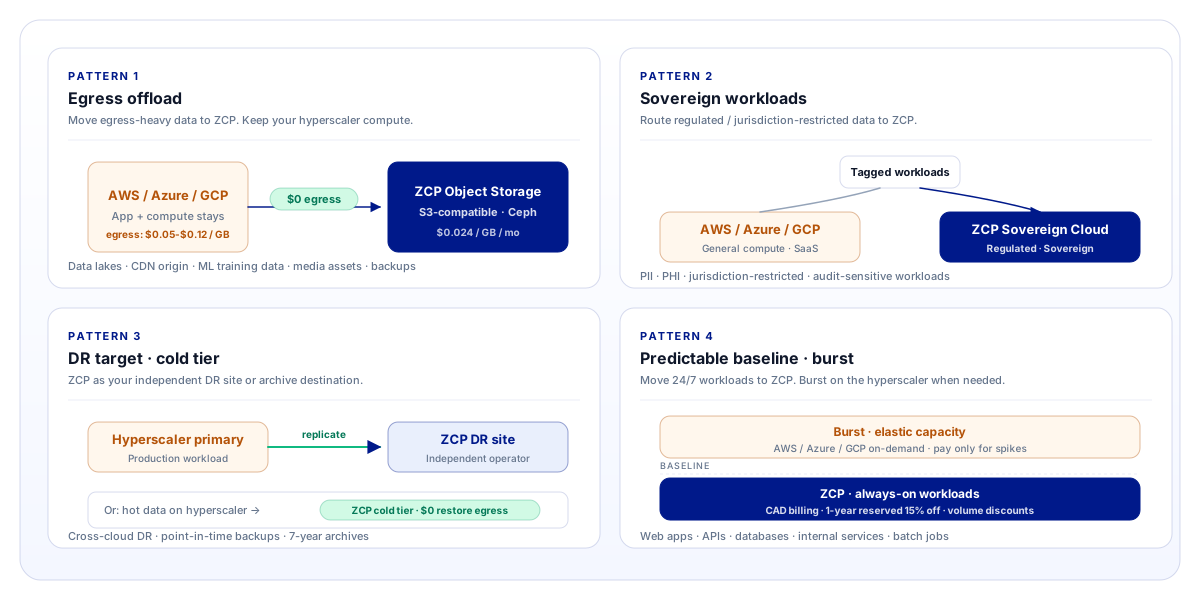
Egress offload
Move egress-heavy data to ZCP. Keep hyperscaler compute.
AWS, Azure, and GCP charge $0.05 - $0.12 per GB to move data out. A 100 TB / month media pipeline or ML training workload spends $5 k - $12 k a month on egress alone. Park the data on ZCP (S3-compatible, $0.024 / GB / mo, $0 egress) and read it from whichever hyperscaler hosts your compute. Your existing boto3, AWS CLI, rclone, and s3cmd workflows work unmodified.
- Data lakes and analytics object stores
- CDN origin for media and static assets
- ML / AI training datasets read repeatedly
- Backup and snapshot retention
- Video, audio, and image archives
Sovereign workloads
Route regulated or jurisdiction-restricted data to ZCP.
You do not have to re-platform everything to satisfy a data-residency requirement on a subset of workloads. Tag workloads needing sovereign isolation and route those to ZCP. The rest of your estate stays on AWS, Azure, or GCP. One operator sits on the contract for the regulated portion, with named legal entity and region selection enforced at the infrastructure layer.
- PII and PHI subject to jurisdictional rules
- Customer data with residency clauses
- Audit-sensitive workloads with disclosure obligations
- Government and quasi-government tenants
- Sector workloads regulators want clearly located
DR target · cold tier
ZCP as your independent DR site or archive destination.
Cross-region DR inside the same hyperscaler still leaves you with single-vendor risk. ZCP gives you an independent DR site under a different operator with auditable replication paths. For long-tail cold data, ZCP cold object storage runs at $0.024 / GB / mo with no restore-egress charges. Restoring a 10 TB archive from a hyperscaler cold tier often costs more than storing it for a year.
- Cross-cloud DR for production hyperscaler workloads
- Point-in-time backups with predictable restore cost
- 7-year regulatory archives
- Snapshot replication to a different operator
- Disaster-recovery exercise targets
Predictable baseline · burst
Move always-on workloads to ZCP. Burst on the hyperscaler.
On-demand hyperscaler VMs cost 3 - 5× the equivalent reserved instance. Reserved instances lock you to a region, instance family, and term. Steady-state workloads pay a flexibility tax for capacity with stable demand. Run the 24/7 floor on ZCP at predictable CAD rates with 1-year reserved at 15 % off and volume discounts past 10 nodes. Keep the hyperscaler for elastic spikes: campaign traffic, batch peaks, model training bursts.
- Web applications and APIs with steady load
- Internal services and admin tooling
- Databases and stateful workers
- Scheduled batch jobs
- Long-running queues and pipelines
Honest scoping
Where the hyperscaler is still the answer.
Hybrid only works if you know what stays where. We are upfront about workloads we are not the best home for, today.
Hyperscaler-native managed services
DynamoDB, Cosmos DB, BigQuery, SageMaker, Bedrock, Vertex AI. If you depend on a hyperscaler-native managed service, keep it there.
Global edge presence
CloudFront, Front Door, Cloud CDN with dozens of PoPs. ZCP has two live regions and five planned, global edge is not our story yet.
Hyperscaler marketplaces
SaaS billed through your hyperscaler marketplace contract. Keep the procurement workflow you have.
Elastic burst
If your traffic spikes 10× and back in minutes, hyperscaler on-demand still wins. ZCP is for the floor, hyperscaler is for the spike.
What customers ask before they pilot
Six questions, answered.
We have AWS / Azure / GCP consumption commits. Is hybrid still viable?
Yes. Hybrid lets you keep using committed-spend services on the hyperscaler, your commit gets credited as you go. Most teams phase ZCP in alongside the existing commit, then negotiate the next commit downward at renewal. ZSoftly engineers help model the phase-in so you do not overpay on either side.
Will our team need to learn a new platform?
Less than you think. ZCP runs standard Linux and Windows, exposes a REST API, has a CLI, and supports Terraform. Object storage is S3-compatible, same SDKs, same tools. Block storage looks like an EBS-style volume. Kubernetes is standard Kubernetes. Your team operates ZCP through interfaces they already know. We handle the platform itself.
How does the network between hyperscaler and ZCP work?
WireGuard or IPSec site-to-site VPN over the public internet is the default and works for most workloads. For latency-sensitive flows we connect via major internet exchanges, with peering paths avoiding hyperscaler egress entirely. Direct private interconnect is available on the Enterprise tier.
Does this complicate our IaC and CI/CD?
No more than running multi-region inside a single hyperscaler. Your existing Terraform, Ansible, and ArgoCD pipelines stay. ZCP slots in as another provider target. We publish reference modules and example pipelines for the four hybrid patterns above.
What if we want to go further and migrate fully?
Hybrid is the entry point. Full migration is a path. Once one pattern proves out, scope a workload-by-workload migration plan. We do not pressure you to commit beyond what is working today.
How quickly is a first pattern ready?
Most teams have one of the four patterns running in a paid 4 - 6 week pilot: scope week 1, ZCP environment provisioned and connected to your hyperscaler week 2, workload moved or replicated weeks 3 - 4, run-rate validation weeks 5 - 6. Pilot cost depends on the pattern. We publish it before you sign.
Or, if you're ready to go further
Hybrid is the entry point. Full migration is a path.
Most customers start with one of the four patterns above. Some keep the hyperscaler indefinitely. Some find the economics work end to end and migrate the rest. We scope the next step from real data, not slides.
Start with one workload
Bring us one workload.
We'll show you the architecture.
30-minute scoping call. Bring the workload hurting the most on your hyperscaler bill, egress-heavy, sovereignty-sensitive, or a stubborn 24/7 floor. We come back with an architecture, a number, and a pilot plan.