Your VMware bill changed.
We've built the way out.
ZSoftly designs, migrates, and operates a dedicated sovereign private cloud for you, on an open-source foundation, billed in CAD. No Broadcom renewal, no per-core math, no proprietary stack to escape twice. Available to teams anywhere in the world.
Free 30-minute scoping call · Published CAD pricing · Migration playbook included · Live YUL & YOW regions
- Starter setup
- $4,500 CAD
- Standard managed
- $2,800 / mo
- Egress
- $0 always
- Foundation
- Open source
What changed
The renewal isn't the renewal you signed.
Broadcom's acquisition of VMware closed in November 2023. Every change below is widely reported across industry press, customer forums, and partner advisories. Take this list into your next call with your VMware rep and ask which ones apply to your renewal.
Perpetual licenses are gone
Broadcom ended VMware perpetual licensing. Every customer is now on subscription with renewal cycles you do not control.
Per-core minimums went up
Many shops report new 16-core-per-CPU minimums and consolidated bundles billing for capacity unused under perpetual licensing.
You buy the bundle, not the product
vSphere Standard buyers were funneled into VMware Cloud Foundation or vSphere Foundation. You pay for vSAN, NSX, Aria, and HCX whether you run them or not.
Partner network reshuffled
Many smaller VMware partners and white-label OEMs were dropped or repriced. Your previous renewal integrator might no longer be in the program.
No price ceiling
Industry reports of 2× to 5× renewal quotes are common. Your forecast for the next contract is whatever Broadcom decides next quarter.
Jurisdiction shift
VMware is now a Broadcom (US-headquartered) product subject to US export rules and corporate policy. For buyers in regulated jurisdictions, this adds a procurement question to every renewal cycle.
What you stop paying for
One CAD invoice. No bundle.
VMware on Broadcom adds line items every year. ZCP Private Cloud is a single managed service in CAD. Here is what each side of the bill contains.
Today
VMware on Broadcom
You renew a subscription bundling software you might not use, on a per-core minimum you might not need, in USD, with a renewal multiplier set by the vendor.
- VCF / vSphere Foundation subscription
- Per-CPU + per-core licensing
- vSAN / NSX / Aria modules in bundle
- Production support (Broadcom)
- Partner / integrator margin
- Internal staff to operate the stack
- FX exposure (USD-billed contracts)
Forecast unknowable beyond current contract. FX risk. Bundle billed even when modules unused.
After migration
ZCP Private Cloud
One monthly invoice in CAD. Open-source foundation. ZSoftly engineers run the platform. Predictable for the length of the contract.
- Compute orchestration (Apache CloudStack)
- Distributed block + object storage (Ceph)
- Firewall + VPN (OPNsense + WireGuard)
- White-label portal (Cloud Management Platform layer)
- Patching, upgrades, security ops
- 24/7 monitoring + alerting (Pro/Enterprise SLA)
- CAD invoicing, no FX exposure
Standard tier: $12,000 setup + $2,800 / mo. All CAD. Volume discounts above 10 nodes.
Want a side-by-side TCO model with your real VMware numbers? Send us your renewal quote and node count. We build a 3-year comparison and walk you through it.
Request TCO model →How the move works
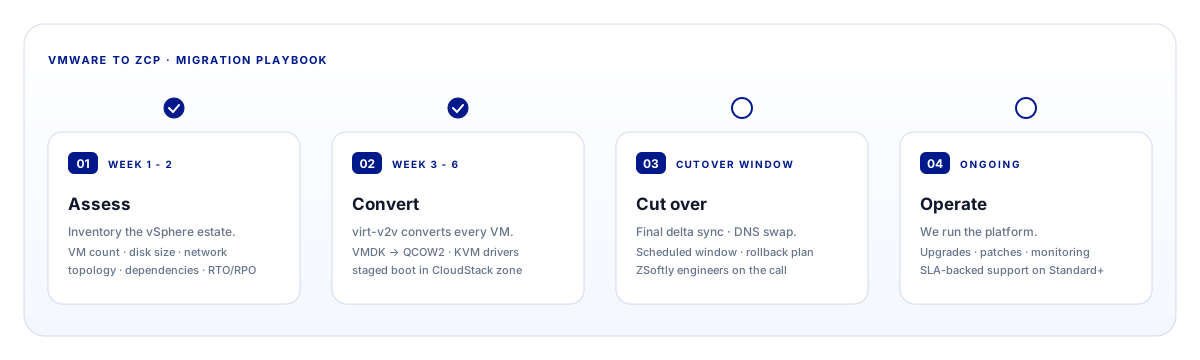
Four phases. ZSoftly runs all of them.
We do not hand you a runbook and wish you luck. ZSoftly engineers own the migration end
to end: assessment, conversion (using the Apache CloudStack 4.19 import tool with
virt-v2v on KVM hosts), cutover, and ongoing operation. The technical mechanics behind each phase
are documented in our step-by-step guide.
Want the technical detail?
Our step-by-step guide walks through the CloudStack 4.19 import tool, KVM host
prerequisites (virt-v2v, virtio-win), Domain and
Account setup, network mapping, and the API path for migrations at scale. Adapted from
the ShapeBlue methodology with operational notes from running this in production.
One-time
Architecture & Design Workshop
$2,500
One-time
Cloud Zone Deployment
$3,500 / zone
One-time
VMware / vSphere Migration
$5,000+ (scoped)
Why customers pick ZCP
Cost, sovereignty, and operations, all three.
Most migrations chase one of these three and concede the other two. ZCP Private Cloud is architected to deliver them together. This is the offer.
Predictable cost
Published CAD pricing. One invoice. Volume discount above 10 nodes. No FX. No surprise bundle. Forecast your 3-year cost on the homepage, then sign for it in the proposal.
Sovereignty by architecture
ZCP is built so data residency, isolation, and jurisdiction selection are enforced at the infrastructure layer. You pick the region, you keep the keys, and the operator on the contract is one named company.
Operated, not handed over
ZSoftly engineers hold the platform. We patch the hypervisors, rotate the storage, renew the certs, and answer the page at 2 a.m. Your team stops being on the hook for CloudStack or Ceph operations.
Built on what already runs the industry
No experimental plumbing.
Apache CloudStack
IaaS orchestration
Ceph
Distributed storage
Kubernetes
Container platform
Prometheus + Grafana
Observability
What customers ask before they sign
The six worries, answered.
What happens to my VMware admin team?
They stay valuable. Core skills carry across: virtualization concepts, networking, storage tiering, backup design. Your team operates ZCP through a portal and API. ZSoftly engineers handle the platform itself, so your admins move up the stack: capacity planning, workload tuning, security review, internal service design.
Will my workloads need to be rewritten?
No. ZCP runs the same OS images you run on vSphere, Linux, Windows Server, BSD. We use the Apache CloudStack 4.19 import tool, which drives virt-v2v on the destination KVM host to convert VMDK to QCOW2 and inject KVM/virtio drivers (including virtio-win for Windows guests). Most workloads do not notice the move. Where there is rework, we scope it during assessment before you sign. The full technical walkthrough is in our step-by-step guide at /blog/vmware-to-cloudstack-migration-guide.
What about vendor lock-in with ZCP?
Our foundation is open source: CloudStack, Ceph, KVM, OPNsense, Prometheus, Grafana. Export your VMs as standard QCOW2 / RAW images and move them to any KVM-compatible operator. Your data is yours, in formats readable without us.
What if I outgrow the Standard tier?
You move to the Enterprise tier, multi-region, customer-supplied colocation if you have a preferred facility, managed Kubernetes layer, and a dedicated ZSoftly engineer. The platform is the same. The operating envelope grows.
Are real customers running on ZCP today?
Yes. ZCP is live in two regions (YUL-1 and YOW-1) with paying customers running production workloads. Ask for references during the scoping call, we provide names and outcome metrics under NDA.
How long does a typical migration take?
Starter-tier shops (under 50 VMs) usually finish in 4 - 8 weeks end to end, including assessment and a planned cutover window. Standard-tier estimates run 8 - 14 weeks. Enterprise-tier engagements are scoped per environment.
Next step
Bring us your renewal quote.
We'll bring you the alternative.
30-minute scoping call. Share your VM count and renewal numbers. Leave with a TCO model and a migration playbook tailored to your environment. No obligation, no slide deck.
ZSoftly Technologies Inc. · 116 Albert St, Suite 300, Ottawa ON K1P 5G3